
The DNA Blueprint: Why Polynucleotides Are Re-Engineering Under-Eye Care
- Abdelrahman Moussa
- 3 hours ago
- 3 min read
There is a shift taking place in clinical aesthetics. For years, the ultimate goal of cosmetic treatments was to alter or add—injecting volume to fill out a shadow, or freezing a muscle to prevent a line. But as we move into an era focused on tissue health and cellular longevity, the demand has pivoted completely toward regenerative aesthetics.
Nowhere is this shift more dramatic than in the delicate under-eye region.
Historically, treating dark circles, hollows, or crepey lower eyelids meant turning directly to traditional tear trough fillers. While hyaluronic acid fillers work beautifully for structural volume loss, the thin skin around the eyes is notoriously unforgiving. Misplaced filler can cause puffiness, a bluish tint under the skin (the Tyndall effect), or product migration over time.
Today, advanced clinics are bypassing artificial volume entirely, using biological building blocks called polynucleotides to structurally repair and thicken the under-eye skin from the inside out.
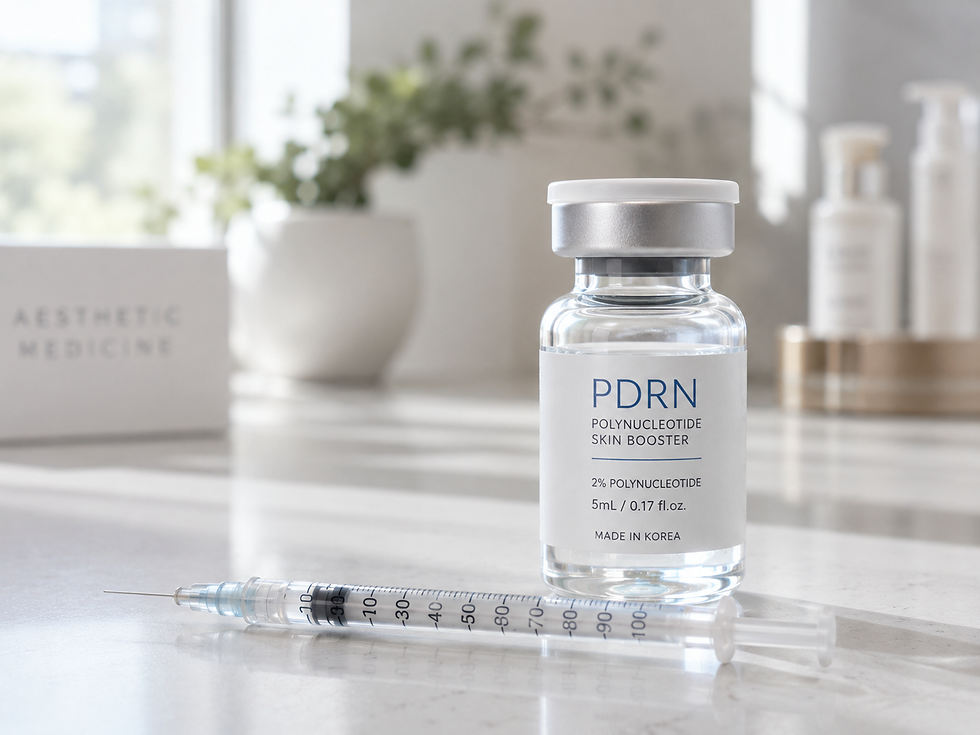
What Exactly Is a Polynucleotide?
If traditional skin boosters act like a temporary micro-sponge that holds onto water, polynucleotides function like a software upgrade for your cells.
Derived from highly purified DNA fragments (typically sourced ethically from salmon DNA), polynucleotides are long chains of nucleotides—the very building blocks of DNA and RNA. They are completely biocompatible, non-immunogenic, and highly stable.
When introduced into the delicate dermal layers around the eyes, they don't simply take up space or add mechanical volume. Instead, they act as biostimulators that unlock a multi-layered healing cascade:
Fibroblast Activation: They directly signal your skin's fibroblast cells to ramp up the production of fresh, high-quality Type I collagen and elastin, restoring true elasticity to sagging lower lids.
Intracellular Hydration: Their molecular structure has a profound affinity for water, binding moisture deep within the tissue planes to plump fine, crepey lines without causing surface fluid retention.
Microcirculation Boost: They stimulate angiogenesis—the formation of healthy new micro-capillaries. This improves oxygen and nutrient delivery to the skin cells, which directly helps fade the vascular darkness and purple hues that cause stubborn dark circles.
Anti-Inflammatory Shielding: They neutralise free radicals and calm localized cellular stress, which makes them uniquely safe for highly sensitive or reactive skin types.
Filler vs. Polynucleotides: Choosing Your Pathway
Understanding the difference between volume-replacing injectables and cell-signaling injectables is essential for planning your rejuvenation journey:
Feature | Tear Trough Dermal Filler | Polynucleotide Skin Boosters |
Primary Mechanism | Instant physical volume restoration (hyaluronic acid). | Intracellular tissue repair and collagen stimulation. |
Best Suited For | Deep, structural bone-deep hollowing under the eyes. | Dark circles, crepey skin texture, fine lines, and thin, lax skin. |
Immediate Result | Instant camouflage of structural shadows. | Gradual improvement in tissue thickness and radiance. |
Risk of Puffiness | Moderate (HA naturally attracts external water molecules). | Extremely low (integrates directly into the skin matrix). |

The Power of "Treatment Stacking"
In modern aesthetic planning, treatments are rarely used in isolation. The most sophisticated, natural outcomes are achieved through personalized combination therapies—often referred to as treatment stacking.
For patients experiencing both deep structural shadows and surface skin laxity, a practitioner might combine deep, structural facial balancing using bone-anchored fillers with superficial polynucleotide micro-injections to refine the overlying skin texture. Similarly, combining microneedling with polynucleotides supercharges the skin's regenerative capacity, creating an exceptionally firm, smooth canvas.
Reclaiming Your Radiance
True under-eye rejuvenation is no longer about masking a shadow or freezing an expression. By feeding your skin the exact biological data it needs to rebuild its own structural scaffolding, you aren't just hiding the signs of fatigue. You are quite literally engineering a thicker, brighter, and more resilient foundation that stands the test of time.



Comments